
Of course, Everyone has heard that SEBI issued an interim order against Rajesh Exports Limited (“Rajesh Exports”), but does that mean Rajesh Exports was involved in a scam? Of course not.
You must understand that the Interim order issued by SEBI doesn’t automatically convict or finalise that Rajesh Exports was involved in any scam. Instead, it was a public statement issued during an ongoing investigation to prevent market manipulation, and protect the investors.
How it started?
It all began when SEBI received a complaint vide e-mail dated March 11, 2024, wherein a shareholder of Rajesh Exports alleged potential financial misrepresentation in the books of Rajesh Exports regarding a large sum of trade receivables outstanding for more than two years.
About Rajesh Exports
Rajesh Exports is a public limited company incorporated on 01-02-1995 (L36911KA1995PLC017077), having its registered office at #4, Batavia Chambers, Kumara Krupa Road, Kumara Park East, Bangalore (560001). The Company is a gold refiner and manufacturer of gold products. It exports its products to various countries around the world, and also sells its products in wholesale and retail in India and through its own retail showrooms under the brand name ‘SHUBH Jewellers’. It is a mid-cap company with an INR 3,210 crore market capitalization as of June 03, 2026.

The financial statements reported consolidated revenue from operations of approximately ₹15.44 lakh crore and standalone revenue from operations of around ₹24 thousand crore during the period from FY21 to FY25. At first glance, these figures may seem extraordinary. But is there anything inherently wrong with a company reporting massive revenues through its subsidiaries? Not at all. Large business groups often generate a significant portion of their revenue through subsidiary companies, and this is a legitimate business structure.
So, if high consolidated revenue wasn’t the issue, what prompted SEBI to issue an interim order against Rajesh Exports? The answer lies not in the size of the revenue but in the company’s inability to substantiate it.
1) Missing Documentation
Regulation 46(2)(s) of the SEBI (Listing Obligations and Disclosure Requirements) (LODR) Regulations, 2015 requires: Every listed entity must upload the separate audited financial statements of each of its subsidiaries for the relevant financial year on its website at least 21 days before the Annual General Meeting (AGM) that considers those financial statements.
One of the most significant findings related to the company’s overseas subsidiaries. Rajesh Exports itself disclosed that nearly 98% of its consolidated revenue originated from its subsidiaries and step-down subsidiaries, particularly entities based in Switzerland. Naturally, if almost the entire business is driven by subsidiaries, investors would expect complete transparency regarding their financial performance.
Rajesh Exports failed to upload the audited financial statements of its subsidiaries as required, thereby depriving shareholders, investors, and regulators of access to the financial information of the entities responsible for generating a substantial portion of the group’s revenue. Even after SEBI sought clarification, the company uploaded only incomplete information on its website.
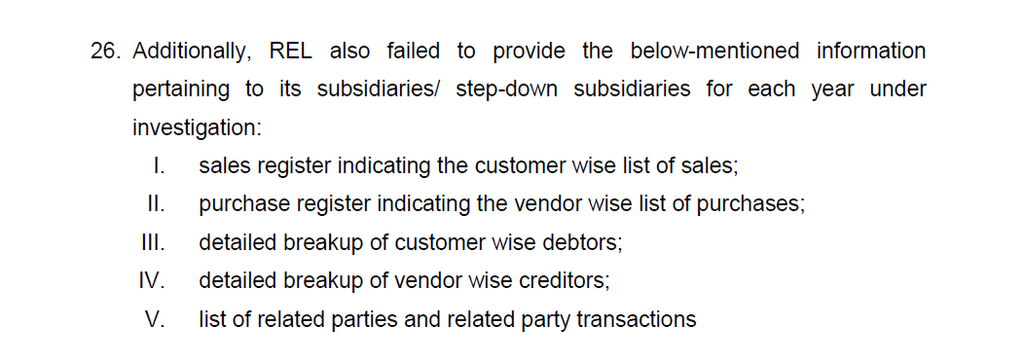
The interim order further notes that the company did not furnish several key documents sought by SEBI. A detailed list of these missing documents is provided in Paragraph 26 (Page 12 of 109) of the interim order.
The company attempted to justify the non-disclosure by arguing that Swiss data protection laws and confidentiality agreements prevented it from sharing information relating to its Swiss subsidiaries. SEBI, however, examined the provisions of the Swiss Federal Act on Data Protection and observed, prima facie, that the legislation protects the personal data of natural persons rather than corporate financial information.
The regulator further noted that the law itself contains exceptions permitting disclosure before competent authorities where necessary. Consequently, SEBI concluded that Swiss privacy laws could not be relied upon to avoid statutory disclosure obligations imposed under Indian securities laws.
Perhaps the most striking issue emerged when SEBI compared the reported revenues of the group’s Swiss entities. Rajesh Exports repeatedly stated that Valcambi SA was the principal operating company responsible for the group’s overseas business. However, the audited standalone financial statements of Valcambi reflected revenues of only a few hundred crores, whereas the consolidated financial statements of the group reported revenues running into several lakh crores.
Rajesh Exports explained that Valcambi recognized only processing charges while another group entity recognized the gross value of gold transactions. SEBI, however, observed that this explanation lacked adequate accounting support, reconciliation statements, ownership records, and transaction-level evidence capable of substantiating such a significant difference.
The concerns did not end there. Throughout the investigation, SEBI repeatedly requested customer-wise sales registers, vendor-wise purchase registers, debtor and creditor break-ups, invoices, related-party transaction details, and inventory records. According to the interim order, many of these records were either incomplete, inconsistent, or not provided at all despite repeated summons.
Even different submissions made by the company reportedly contained material inconsistencies in customer names and sales figures, making it increasingly difficult for investigators to reconcile the information and independently verify the reported financial statements.
2) Circular Trading
One of the most striking findings in SEBI’s order revolves around Affluence Shares and Stocks Private Limited, a SEBI-registered stockbroker. According to Rajesh Exports, the company recorded over ₹11,400 crore in sales and an almost identical ₹11,400 crore in purchases with Affluence between FY 2021-22 and FY 2023-24. In certain years, these transactions accounted for nearly 85% of Rajesh Export’s standalone revenue.
What immediately caught SEBI’s attention was the near-perfect symmetry between the purchase and sale values. Despite transactions worth thousands of crores, Rajesh Exports reported virtually no profit margin from these dealings an unusual pattern often associated with round-tripping rather than genuine commercial activity. The inconsistencies deepened during the investigation.
Company’s GST records contained no purchase transactions involving Affluence. When SEBI sought confirmation from the broker, Affluence categorically denied ever having Rajesh Exports as a client. It stated that no agreement existed between the two companies, and that it had never executed any trades on Rajesh Exports’ behalf.
Instead, Affluence confirmed that it maintained a personal trading account of Rajesh Mehta, through which he traded gold derivatives on 102 separate trading days. When SEBI compared Rajesh Exports’ books with Mehta’s personal contract notes, the transactions matched almost line by line. The fund flow further strengthened SEBI’s concerns.

Rajesh Exports transferred approximately ₹7.45 crore to Mehta personally, who then used the funds to trade gold derivatives through Affluence. After incurring losses of nearly ₹3.5 crore, the remaining balance was returned, and a portion of it was transferred back to Rajesh Exports. In essence, personal derivative trades were reflected in Rajesh Exports‘ financial statements as over ₹11,000 crore of company-to-company sales and purchases.
Rajesh Exports later argued that Mehta had merely acted as a “conduit” to execute gold trades on the MCX because of certain litigation-related constraints. However, SEBI found no board approvals, contractual agreements, or documentary evidence supporting this explanation. Consequently, the regulator viewed the Affluence transactions as prima facie non-genuine and circular entries, allegedly used to artificially inflate reported sales and purchase figures.
3) Increasing Receivables
As SEBI examined the company’s financial records, a significant pattern emerged. Across three consecutive financial years, nearly 98% to 99% of Rajesh Exports‘ standalone trade receivables were concentrated in just four overseas entities: Al Jameelat Jewellery LLC, Al Sultan Jewellery LLC, Aurofin SA, and ESG Edelmetall Handel GmbH.
At its peak, the outstanding amount due from these four counterparties alone stood at approximately ₹4,900 crore, raising serious concerns over the concentration and recoverability of these receivables.
In its initial response, Rajesh Exports informed SEBI that none of these entities were related parties and asserted that no receivables had been written off, adjusted, or settled through any unusual arrangements. However, SEBI’s investigation painted a different picture.
The regulator discovered that the receivables balance had reduced by nearly ₹2,914 crore, not through actual cash collections, but largely through accounting adjustments. These involved offsetting receivables owed by one overseas entity against payables due to entirely different counterparties, including firms such as Valcambi SA and Basma Jewellery LLC.
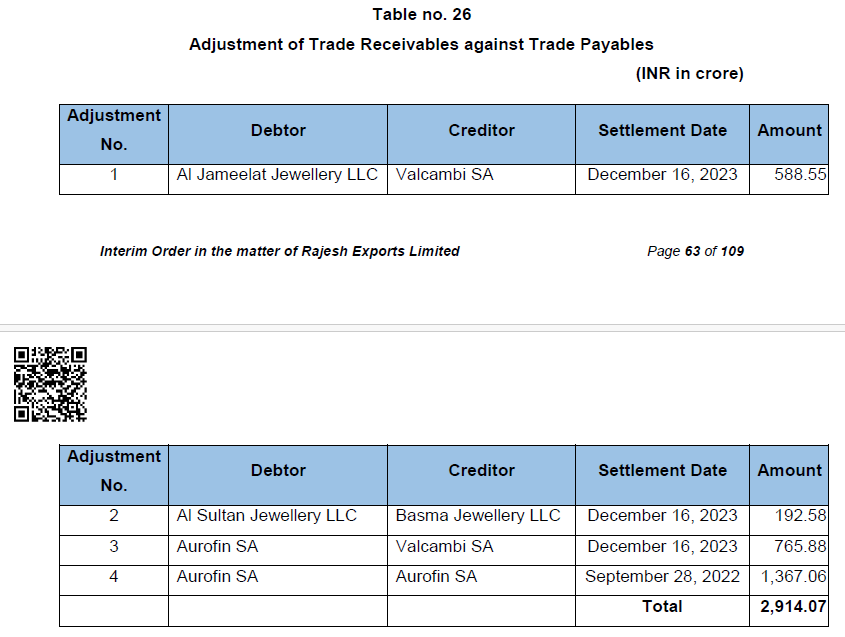
Such cross-adjustments between separate entities prompted SEBI to scrutinize the commercial rationale and transparency of these transactions more closely.
4) The Vanishing African Gold Mines
Perhaps the boldest single claim in Rajesh Exports’ books was an investment described as being in gold mines in Africa. It first surfaced because Rajesh Exports’ “Other Non-Current Investments” ballooned from about ₹880 crore in 2021 to over ₹10,500 crore by 2025, and when the NSE asked Rajesh Exports to explain roughly ₹1,035 crore of that figure back in 2024, company answered that it represented an investment in African gold mines.
SEBI went looking for that investment in Rajesh Exports’ own standalone accounts, in the accounts of its Singapore subsidiary, and in the consolidated accounts of its Swiss refining arm, Global Gold Refineries, and found no trace of it anywhere. When confronted, Rajesh Exports’ explanation amounted to saying the investment existed “through foreign subsidiaries” and that the figures were “tallying and correct,” without producing a single reconciliation statement, valuation report, or document linking the number to any actual mine, licence, or asset.
SEBI’s language on this point is unusually blunt for a regulatory order: it calls Rajesh Exports’ explanation “vague, unsupported and incapable of verification.”
5) Fund Routing
Separately, SEBI’s forensic review of Rajesh Exports’ bank statements turned up a pattern of company money flowing through the personal bank accounts of Rajesh Exports’ own promoter and Executive Chairman, Rajesh Mehta, and of his son, Siddharth Mehta. Between April 2020 and September 2025, Rajesh Exports transferred about ₹339 crore into Rajesh Mehta’s personal accounts, and about ₹232 crore flowed back; a churn that left a residual gap SEBI could not fully reconcile.
None of this appeared as related-party disclosure in Rajesh Exports’ annual reports, where Mehta’s declared remuneration was listed at just ₹1.2 lakh a year. Among the specific transfers: ₹77 crore routed through Mehta’s account to fund a demand draft payable to the Registrar General of the Karnataka High Court, and other sums whose purpose Rajesh Exports simply recorded as “unknown.”
In his own deposition, Mehta and Rajesh Exports both admitted the routing was deliberately done, they said, to keep Rajesh Exports’ actual bank accounts confidential, to park funds ahead of court proceedings, and to move money “without revealing the bank account from which the funds had come.” SEBI’s order treats that last admission as effectively describing its own concealment.
A similar pattern shows up with Siddharth Mehta, whose company executives told SEBI he had no formal role at Rajesh Exports at all, yet who received roughly ₹21 crore from the company, much of it run through his personal credit cards for “operational expenses” that didn’t reconcile against the roughly 140 credit card statements Rajesh Exports eventually supplied.
The pattern extends into Elest Pvt Ltd, a lithium-battery and EV manufacturing company incorporated by Rajesh Mehta and his brother Prashant with just ₹1 lakh in starting capital. Rajesh Exports’ bank statements show ₹566 crore moving from Rajesh Exports into Elest over five years, with only ₹350 crore coming back a net one-way outflow of about ₹216 crore that was never disclosed as a related-party transaction and was only partially covered by board approvals.
Rajesh Exports’ own Managing Director and CFO told SEBI under deposition that they were unaware of most of these transfers, having only signed off on a ₹200 crore equity investment and a ₹75 crore loan.
Conclusion
Taken together, SEBI’s interim findings raise serious questions about the reliability of Rajesh Exports‘ reported financial position and business transactions. The regulator has pointed to receivables being adjusted against payables involving entities whose existence could not be independently verified, an overseas gold mine investment that appears inconsistent with the financial records of the subsidiaries meant to own it, substantial company funds allegedly routed through the personal bank accounts and credit cards of the chairman and his son without documented board approval, and an alleged ₹11,000-crore trading relationship with a stockbroker that the broker itself denies ever existed.
Viewed individually, each issue might invite a separate explanation. However, when considered collectively, SEBI has described them as part of a broader pattern of questionable accounting practices, circular fund movements, and inadequate disclosures. The developments have also coincided with a dramatic erosion in shareholder value, with a company that once commanded a market capitalization of around ₹30,000 crore losing a significant portion of its market worth as these concerns came to light.
That said, it is important to remember that these are interim, prima facie observations, not final judicial findings. Rajesh Exports and its promoters will have the opportunity to present their defence during the regulatory proceedings. Until the matter reaches its conclusion, the allegations remain subject to due process, making it essential to distinguish between SEBI’s preliminary observations and any final determination of liability.
Read about famous Scandals