
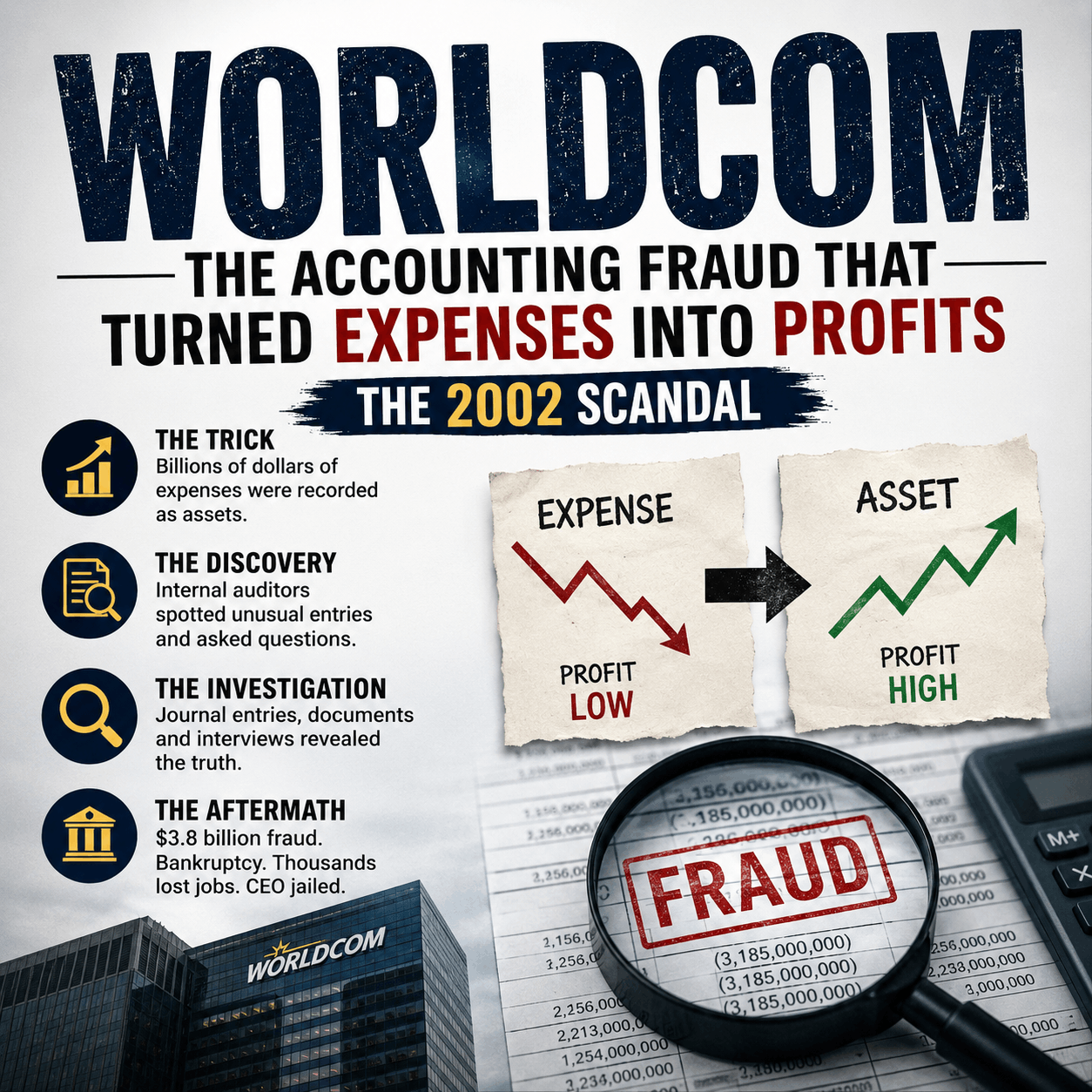
When people hear about corporate frauds, they often imagine complicated financial structures, offshore companies, or hidden bank accounts. However, the WorldCom scandal proved that one of the biggest accounting frauds in history was built on something surprisingly simply changing the way expenses were recorded.
WorldCom did not create hundreds of shell companies like Enron. Instead, it manipulated a basic accounting principle. Ordinary operating expenses were recorded as long-term assets, making a loss-making company appear highly profitable. This simple decision misled investors, banks, regulators, and even the market for several years. The scandal eventually led to one of the largest corporate bankruptcies in U.S. history and became a landmark case for forensic accountants, auditors, and regulators worldwide.
Background
WorldCom was founded in 1983 as a small telecommunications company in the United States. Through a series of aggressive acquisitions during the 1990s, it rapidly grew into one of the world’s largest telecom companies, serving millions of customers across the globe. At its peak, WorldCom was considered a Wall Street success story. Investors admired its rapid growth, its market value exceeded USD 180 billion, and management consistently promised strong financial performance. However, by the early 2000s, the telecommunications industry began slowing down. Competition intensified, demand weakened, and the company’s profits started declining.
Management now faced enormous pressure. Falling profits meant a falling share price, disappointed investors, and the risk of losing market confidence. Instead of accepting the reality, senior executives chose to manipulate the company’s financial statements.
How the Fraud Worked
The fraud revolved around one major expense known as line costs. Whenever WorldCom used another telecom company’s network to complete customer calls, it had to pay a fee. These payments were normal operating expenses and, under accounting principles, should have been charged directly to the Profit & Loss Account. Instead, WorldCom recorded billions of dollars of these expenses as assets on the Balance Sheet.
To understand why this mattered, imagine a business earning ₹100 crore in revenue while incurring ₹80 crore in expenses. Its actual profit would be ₹20 crore. If ₹30 crore of those expenses were incorrectly recorded as machinery instead of expenses, reported expenses would fall to ₹50 crore, and profit would suddenly increase to ₹50 crore, even though the business had earned the same amount of cash. Nothing had changed economically. Only the accounting treatment had changed.
That is precisely what WorldCom did on a massive scale. By treating ordinary expenses as assets, it significantly reduced reported expenses and artificially inflated profits, creating the illusion of a financially healthy company.
How Was the Fraud Discovered?
Unlike many corporate scandals, the WorldCom fraud was uncovered by its own Internal Audit team rather than by external parties. The investigation began when internal auditors noticed unusually large accounting entries moving billions of dollars into asset accounts. Curious about these entries, they requested supporting documents, contracts, invoices, and management approvals.
- The evidence simply wasn’t there.
There were no new telecom networks, no additional infrastructure, and no major assets that justified such huge capital additions. Yet the Balance Sheet showed billions of dollars of new assets.
- This inconsistency raised serious concerns.
The internal auditors expanded their review, analysing journal entries, the general ledger, fixed asset records, and accounting policies. They discovered that operating expenses had been deliberately transferred into capital expenditure accounts through manual journal entries.
- The accounting records balanced perfectly, but the underlying business reality did not.
Once regulators and forensic accountants became involved, they reconstructed the financial statements by reversing these improper entries. The results were shocking. The company that had reported impressive profits was actually suffering substantial losses.
The Investigation
Forensic investigators approached the case methodically. They examined journal entries to identify unusual manual adjustments, reviewed supporting documents for every significant capital addition, interviewed finance employees, and compared accounting records with the company’s actual business operations. One of the strongest pieces of evidence was the complete absence of documentation supporting billions of dollars classified as assets. Employees admitted that many of these entries were made under instructions from senior management, despite having no commercial justification.
By tracing the accounting adjustments and reconstructing the financial statements, investigators proved that the company’s reported profits were not genuine but were created through intentional misclassification of expenses.
Consequences
The fraud ultimately involved approximately USD 3.8 billion of improperly capitalized expenses, with additional accounting irregularities discovered later. In 2002, WorldCom filed for bankruptcy, making it one of the largest corporate failures of its time. Thousands of employees lost their jobs, investors lost billions of dollars, and CEO Bernard Ebbers was convicted and sentenced to prison for his role in the fraud.
The scandal also reinforced the importance of strong internal controls, independent auditing, and ethical corporate governance.
The WorldCom scandal demonstrates that fraud does not always involve sophisticated schemes. Sometimes, a simple accounting adjustment can completely change how a company’s financial performance appears. For forensic accountants, the case highlights the importance of questioning unusual journal entries, verifying whether recorded assets actually exist, comparing profits with cash flows, and ensuring that accounting treatment reflects economic reality rather than management’s desired results. Perhaps the biggest lesson from WorldCom is that financial statements should never be accepted at face value. Every number tells a story, and it is the responsibility of a forensic investigator to determine whether that story reflects the truth.
Read More Case Studies:
- Enron Scandal (2001)
- Satyam (2009)
- Nirav Modi-PNB
- Wirecard (2020)
- Luckin Coffee (2020)