
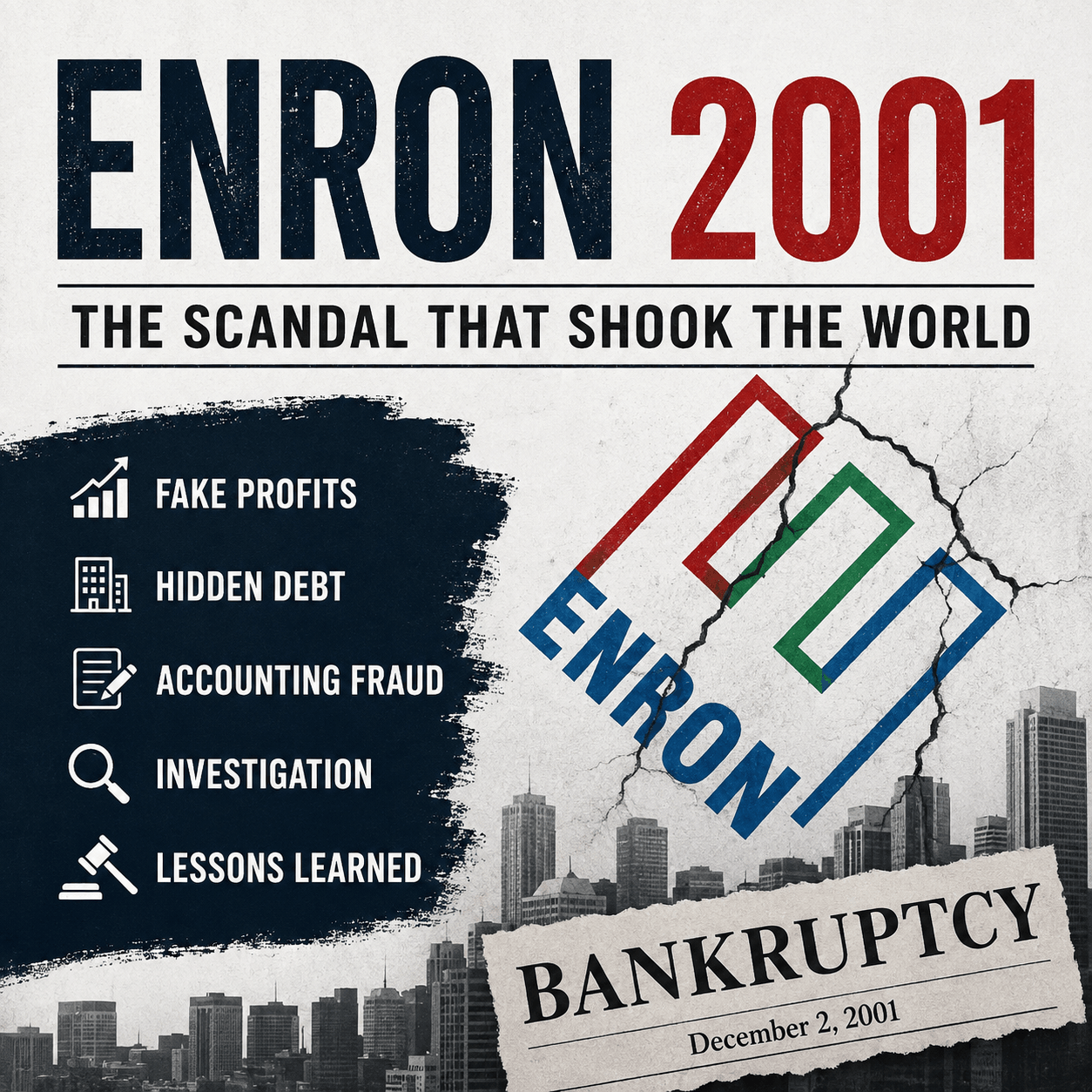
Enron (2001): Imagine investing your life’s savings in a company that is consistently ranked among the most innovative businesses in America. Every quarter, the company reports record profits, analysts recommend buying its shares, and its management is admired across the corporate world. Then, almost overnight, everything collapses.
- The profits were fake
- The debt was hidden
- The financial statements were manipulated
- Thousands of employees lost their jobs, investors lost billions of dollars, and one of the world’s largest accounting firms disappeared forever.
Thousands of employees lost their jobs, investors lost billions of dollars, and one of the world’s largest accounting firms disappeared forever. Even today, the Enron scandal remains one of the most studied corporate frauds because it demonstrated how management, weak governance, and unethical accounting practices can deceive investors for years.
Background of Enron
Enron Corporation was established in 1985 through the merger of Houston Natural Gas and InterNorth. Initially, it operated as a natural gas pipeline company. Under the leadership of CEO Kenneth Lay, Enron gradually transformed itself into an energy trading giant. Instead of merely transporting natural gas, the company started trading electricity, natural gas contracts, broadband services, weather derivatives, and other financial products. By the late 1990s, Enron was considered one of the fastest-growing companies in the United States.
- Revenue exceeding USD 100 billion.
- Operations in more than 40 countries.
- Thousands of employees.
- Recognition as “America’s Most Innovative Company” for several consecutive years.
To investors, Enron appeared to be a remarkable success story. However, behind this impressive image lay one of the largest accounting frauds ever committed.
The Pressure to Show Continuous Growth
Enron’s share price became the company’s biggest obsession. Senior management strongly believed that if the company’s reported profits slowed down, investors would lose confidence and the market value would decline. As a result, management focused more on maintaining a rising share price than on generating genuine profits. This created immense pressure to report higher earnings every quarter. Unfortunately, instead of improving business performance, management chose to manipulate financial statements.
How Did the Fraud Begin?
The fraud did not happen overnight. It started with relatively small accounting manipulations that gradually evolved into an extremely complex network of hidden debt and fictitious profits. The management realized that if losses could be hidden and profits could be inflated, investors would continue believing that the company was financially strong. To achieve this, Enron adopted several deceptive accounting techniques.
Technique 1: Mark-to-Market Accounting
One of Enron’s most controversial practices was the aggressive use of Mark-to-Market Accounting. Normally, businesses recognize revenue when it is earned over time. Enron, however, estimated the total profit expected from a long-term contract and recorded the entire projected profit immediately, even though the cash had not yet been received.
- Suppose Enron signed a 10-year electricity supply contract expected to generate USD 100 million in profit. Instead of recording profits gradually over ten years, Enron estimated the future earnings and recognized almost the entire expected profit in the first year. If the project later became unprofitable, management simply revised assumptions or transferred the losses elsewhere. This created an illusion of continuously increasing profitability.
Technique 2: Special Purpose Entities (SPEs)
The most infamous aspect of the Enron fraud involved the use of Special Purpose Entities (SPEs). An SPE is a separate legal entity that can legitimately be used for financing or risk-sharing. However, Enron abused these entities to hide debt. Management created hundreds of SPEs and transferred billions of dollars of liabilities from Enron’s balance sheet to these entities.
- Debt appeared much lower than reality.
- Financial ratios looked healthier.
- Investors believed the company was financially stable.
- Credit rating agencies continued giving favourable ratings.
Technique 3: Hiding Losses
Whenever one of Enron’s business projects started losing money, management avoided recognizing the loss in Enron’s financial statements. Instead, the loss-making assets were transferred to SPEs. Consequently, Enron’s reported financial statements continued showing profits even while the underlying business performance deteriorated.
Technique 4: Manipulating Financial Statements
Management employed several methods to make the financial statements appear stronger than they actually were.
- Inflating revenues.
- Delaying recognition of losses.
- Hiding liabilities.
- Overvaluing assets.
- Recording estimated profits as actual earnings.
Why Didn’t the Auditors Detect It?
Enron’s statutory auditor was Arthur Andersen, one of the world’s largest accounting firms at that time. Arthur Andersen failed to challenge management aggressively and accepted many of Enron’s complex accounting treatments. The firm also earned substantial consulting fees from Enron, creating concerns about auditor independence. During subsequent investigations, it was revealed that certain audit-related documents had been destroyed after regulatory scrutiny began. Although Arthur Andersen’s conviction was later overturned by the U.S. Supreme Court, the reputational damage was irreversible, and the firm ceased auditing public companies. This case became one of the strongest reminders of the importance of auditor independence, professional skepticism, and proper document retention.
The Investigation: How Was the Fraud Uncovered?
The fraud did not come to light because of a routine audit. Instead, several events gradually exposed the truth.
Internal Concerns
Some employees noticed unusual accounting practices and questioned the company’s financial reporting. One of the most significant voices was Vice President Sherron Watkins, who raised concerns internally about the accounting irregularities. Although her warnings did not immediately stop the fraud, they later became an important part of the investigation.
Journalistic Investigation
Financial journalists began questioning Enron’s unusually complex financial structure. Investigative reporting highlighted the company’s extensive use of SPEs and raised doubts about its reported profitability. Public scrutiny increased significantly.
Regulatory Investigation
The U.S. Securities and Exchange Commission (SEC) launched a formal investigation after reviewing Enron’s disclosures. Investigators examined annual reports, financial statements, board minutes, contracts, SPE structures, accounting entries, internal emails, and auditor working papers.
- Forensic accountants reconstructed the company’s financial position by: Analysing journal entries, Reviewing accounting adjustments, Tracing transactions between Enron and SPEs, Comparing cash flows with reported profits, Examining related-party transactions, Identifying hidden liabilities, Verifying supporting documentation.
- Investigators interviewed: Senior executives, Finance personnel, External auditors, Board members, Employees associated with SPEs.
Documentary Evidence
Thousands of emails, contracts, accounting records, board papers, and transaction documents were analysed. Investigators compared these records with publicly reported financial statements and discovered numerous inconsistencies. By combining documentary evidence, accounting analysis, interviews, and transaction tracing, investigators demonstrated that the misleading financial reporting was not accidental but the result of deliberate decisions.
What Happened After the Investigation?
- Enron filed for bankruptcy in December 2001.
- Shareholders lost billions of dollars.
- Employees lost jobs and retirement savings.
- Several senior executives were prosecuted.
- Arthur Andersen effectively collapsed as a major audit firm.
- Investor confidence in corporate reporting was shaken worldwide.
Lessons for Accountants and Forensic Professionals
- Never rely solely on reported profits; compare them with cash flows.
- Complex corporate structures deserve heightened scrutiny.
- Related-party transactions require careful examination.
- Auditor independence is essential.
- Professional skepticism is not optional.
- Weak corporate governance can enable fraud.
- Strong internal controls and transparent disclosures protect stakeholders.
- Forensic investigations rely on evidence, transaction tracing, interviews, and corroboration: not assumptions.
The Enron scandal was far more than an accounting failure. It was a breakdown of ethics, governance, oversight, and accountability. What appeared to be one of the world’s most successful companies was, in reality, hiding debt, overstating profits, and misleading investors through sophisticated accounting structures. For forensic accountants, Enron remains one of the most valuable case studies because it demonstrates that fraud is rarely uncovered through a single document or one suspicious transaction. Instead, it is revealed by patiently connecting financial records, cash flows, corporate structures, emails, interviews, and documentary evidence until the complete picture emerges. The lessons from Enron continue to influence forensic investigations, auditing standards, corporate governance practices, and financial reporting across the world.
Read about famous Scandals