
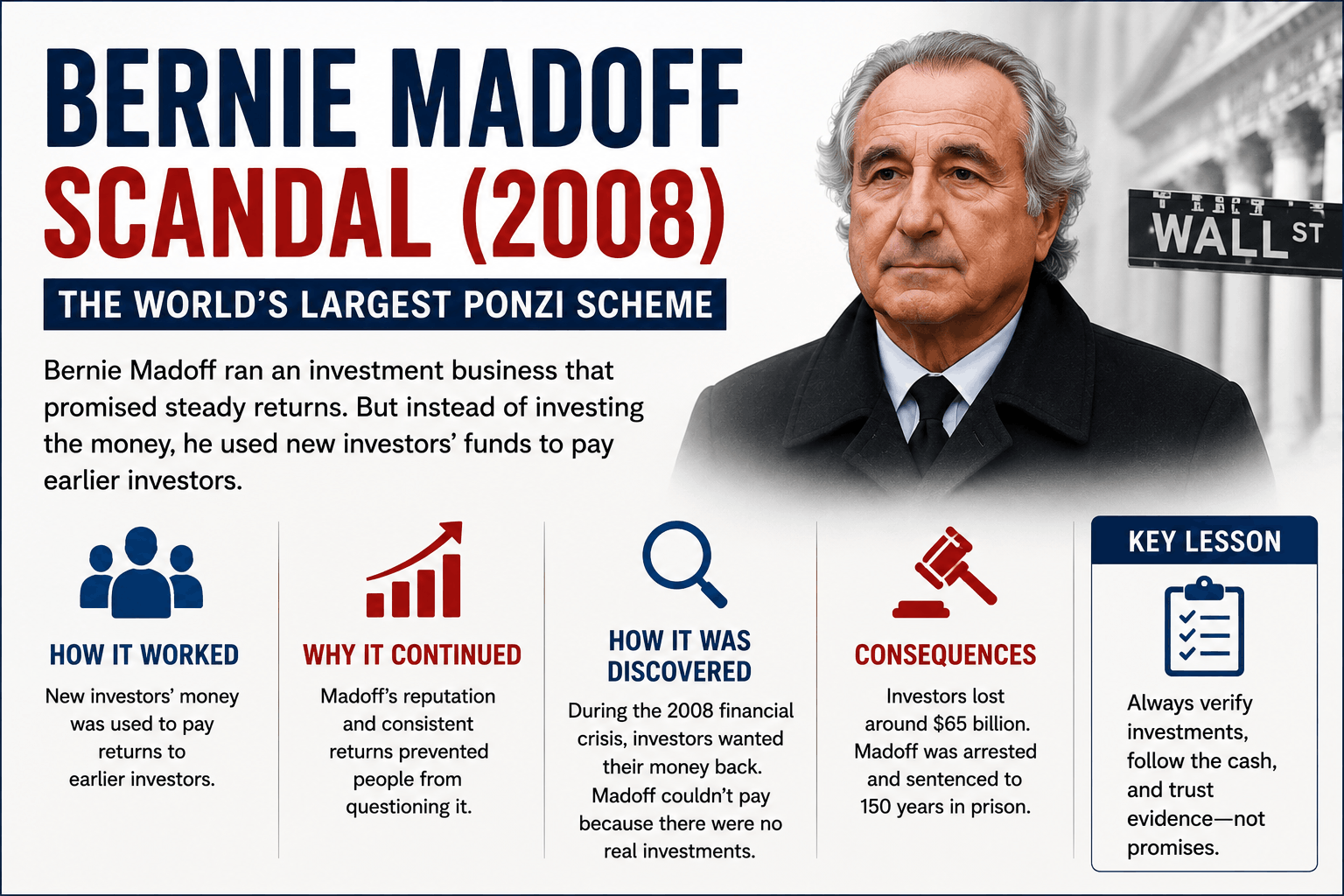
For decades, Bernie Madoff was one of the most respected names on Wall Street. He was a successful investment manager, served as Chairman of NASDAQ, and was trusted by wealthy families, charities, celebrities, and financial institutions across the world. Investors believed their money was being managed by one of the safest professionals in the industry.
Year after year, Madoff’s investment fund reported steady and attractive returns, even when financial markets were experiencing significant ups and downs. While other investment firms struggled during market crashes, Madoff’s fund continued to generate consistent profits. Instead of raising suspicion, this remarkable consistency attracted even more investors.
The reality, however, was shocking. There were no successful investment strategies, no extraordinary market insights, and in many cases, no genuine investments at all. The returns paid to existing investors were simply funded using money received from new investors. What appeared to be a highly successful investment business was actually the largest Ponzi scheme in history.
How Did the Fraud Work?
A Ponzi scheme is an investment fraud where returns paid to existing investors do not come from business profits but from money invested by new participants.
Imagine ten people each invest ₹10 lakh in a fund. Instead of investing the ₹1 crore in the stock market, the fraudster keeps the money. When the first investors expect returns, the fraudster pays them using money collected from new investors. As long as new investors continue joining, the scheme appears successful. Investors receive regular statements showing profits, encouraging them to invest even more or recommend the fund to friends and family. This was exactly how Bernie Madoff operated for many years.
Why Didn’t Anyone Suspect It?
One reason the fraud survived for so long was Madoff’s reputation. Investors trusted him because he was a well-known figure in the financial industry. Many believed that if someone of his stature managed their investments, there was little reason to question the results.
Another reason was the consistency of returns. Genuine investment portfolios fluctuate with market conditions, but Madoff’s fund reported positive returns with unusual regularity. Ironically, what should have been a warning sign was seen as evidence of exceptional investment skill. Many investors never asked independent questions about where their money was invested or whether the reported trades had actually taken place.
How Was the Fraud Discovered?
The scheme continued for years because new investments kept flowing into the fund. However, the 2008 global financial crisis changed everything. As markets crashed, many investors wanted their money back. Suddenly, thousands of redemption requests arrived at the same time.
Under normal circumstances, an investment manager would sell securities and return the investors’ money. Madoff couldn’t.
There were no investments large enough to support the withdrawals. The business had become entirely dependent on receiving fresh money from new investors. When that flow stopped, the entire scheme collapsed. Unable to meet redemption requests, Madoff admitted the truth to his sons, who immediately informed the authorities.
The Investigation
Once investigators became involved, they quickly discovered that the investment records did not match reality. Forensic accountants compared investor statements with actual market transactions and found that many of the trades shown on customer reports had never occurred. Bank records revealed that investor funds were not being invested as claimed. Instead, new deposits were repeatedly used to pay earlier investors.
Investigators reviewed trading records, bank accounts, accounting documents, and electronic communications. They interviewed employees, analysed cash flows, and traced the movement of investor money. The evidence consistently pointed to one conclusion: the business was not generating investment profits. It was simply recycling investors’ money.
Cash flow analysis became one of the strongest pieces of evidence. Rather than earning returns through investments, the scheme relied almost entirely on new deposits to survive.
Consequences
- The collapse of the scheme caused losses estimated at approximately USD 65 billion based on account statements, making it the largest Ponzi scheme ever uncovered.
- Thousands of investors lost substantial amounts of money, including charities, pension funds, businesses, and individuals who had invested their life savings.
- Bernie Madoff pleaded guilty to multiple criminal charges and was sentenced to 150 years in prison, one of the longest sentences ever imposed for financial fraud in the United States.
- The case also prompted regulators and financial institutions to strengthen oversight of investment managers and improve investor protection measures.
The Madoff scandal demonstrates that reputation should never replace verification. Even the most respected individuals and institutions must be subject to independent scrutiny. Forensic accountants should always question investment returns that appear unusually consistent, verify whether reported transactions actually occurred, analyse cash flows instead of relying solely on statements, and obtain independent confirmations wherever possible. Perhaps the most important lesson is that every investment should leave an independent trail of evidence. If profits cannot be verified through actual transactions and cash movements, they should never be accepted simply because they appear on a statement.
The Bernie Madoff case remains a powerful reminder that fraud can survive for years when trust replaces verification and that careful forensic investigation can reveal the truth hidden behind even the strongest reputations.
Read about famous Scandals