
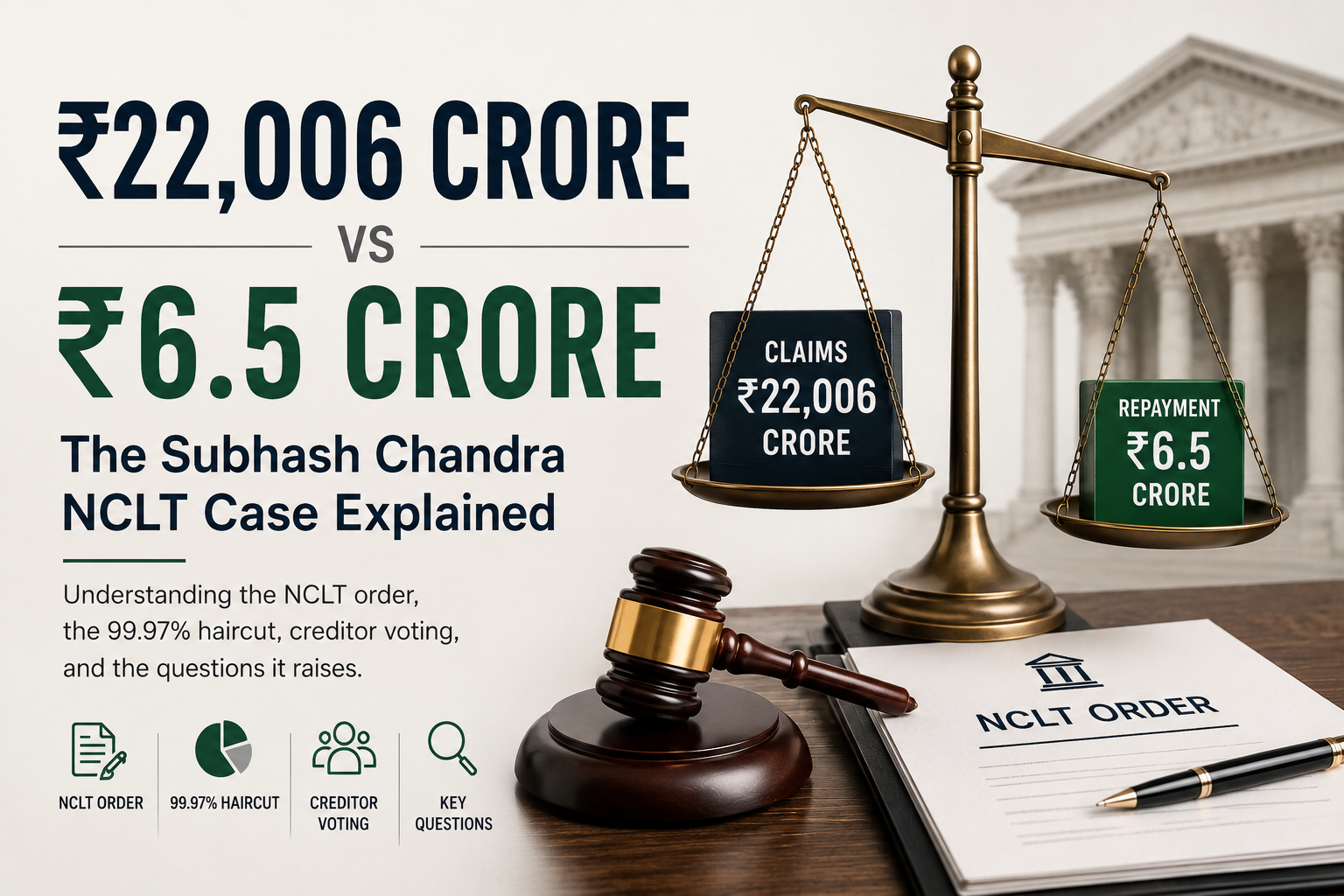
At first glance, the numbers seem almost impossible to believe in Subhash Chandra NCLT Case.
₹22,006 crore.
That is the amount of claims reported in the personal insolvency proceedings involving Essel Group founder Subhash Chandra.
Now look at the other number:
₹6.5 crore.
That is the amount proposed under the repayment plan, approximately ₹6.25 crore for creditors and ₹25 lakh towards the insolvency process. Put the two numbers together and the headline is startling: ₹22,006 crore versus ₹6.5 crore. Based purely on these figures, creditors would recover only around 0.03% of the admitted claims, implying a haircut of approximately 99.97%.
But there is much more to this case than a shocking percentage.
The proceedings raise important questions about personal guarantees, insolvency law, creditor voting, asset valuation, recoverability and the real value of a promoter’s guarantee. And perhaps the biggest question of all is this:
What is a ₹22,000 crore guarantee really worth if the guarantor’s personal assets cannot generate anything close to that amount?
First, What Actually Happened?
One of the easiest ways to misunderstand the case is to assume that Subhash Chandra personally borrowed ₹22,006 crore.
That is not what the figure represents.
The proceedings relate to his role as a personal guarantor for loans taken by companies associated with the Essel Group. In simple terms, imagine a company borrows ₹1,000 crore from a bank and its promoter (owner) gives a personal guarantee for that borrowing. If the company defaults, the lender may have a claim against the guarantor, subject to the terms and enforceability of the guarantee (Promoter in this example).
That distinction is crucial here.
According to the material surrounding the proceedings, the ₹22,006 crore figure represents claims filed against Chandra in his capacity as a guarantor. It does not mean that he personally received ₹22,006 crore in cash from lenders. Chandra has also publicly clarified this distinction. According to his statement, around ₹22,006 crore of claims were filed during the insolvency proceedings, of which approximately ₹21,696 crore were admitted. However, he has argued that the creditors currently opposing the repayment plan had claims of approximately ₹3,992 crore.
That makes the situation considerably more nuanced than the simple headline of “₹22,000 crore debt settled for ₹6.5 crore.”
So Why Is Only ₹6.5 Crore Being Paid?
This is probably the most important question. If the claims are worth thousands of crores, why would a repayment plan involving only ₹6.5 crore be accepted?
The answer lies in a concept that is central to insolvency proceedings:
Recoverability.
Imagine that someone owes you ₹1,000 crore. On paper, that sounds enormous. But suppose an investigation of the person’s assets shows that only ₹5 crore can realistically be recovered. The assets may be illiquid, pledged, encumbered, difficult to sell or otherwise unavailable for immediate recovery.
You now have a choice.
You could reject a settlement and pursue other legal remedies. But if the alternative process ultimately produces an even smaller recovery, accepting the proposed amount may make economic sense. That is essentially the question insolvency proceedings have to address.
The issue is not simply:
“How much does the debtor owe?”
It is also:
“How much can realistically be recovered?”
The NCLT considered the valuation of Chandra’s realisable personal estate and the potential recovery under bankruptcy proceedings. The tribunal’s decision therefore should not be interpreted as saying that ₹6.5 crore is somehow economically equivalent to ₹22,006 crore. Rather, the issue was whether the proposed resolution plan was legally valid and whether it offered a commercially preferable outcome compared with the available alternatives.
What Does the 99.97% Haircut Actually Mean?
Let’s put the numbers into perspective.
- Claims: approximately ₹22,006.57 crore
- Amount proposed for creditors: approximately ₹6.25 crore
- Recovery: approximately 0.03%
- Haircut: approximately 99.97%
Those numbers are undeniably dramatic. But there is an important distinction that often gets lost in discussions about the case. The 99.97% haircut relates to the recovery under Subhash Chandra’s personal-guarantor insolvency proceedings. It does not automatically mean that ₹22,006 crore of underlying corporate loans have simply disappeared.
The companies that borrowed the money are separate legal entities. For example, if Company A borrowed ₹1,000 crore and Subhash Chandra provided a personal guarantee, proceedings against Chandra do not necessarily eliminate Company A’s underlying liability. Depending on the individual loan arrangements, creditors may have other recovery avenues involving the principal borrower, security, collateral or other obligors.
In other words:
Corporate debt and personal-guarantee liability are connected, but they are not identical.
That distinction is essential to understanding what the NCLT decision actually means.
The Asset Valuation Question
This is where the case becomes particularly interesting from a forensic perspective.
Creditors reportedly questioned the substantial difference between historical estimates of Chandra’s wealth and his present disclosed or realisable personal assets. Figures cited in the proceedings reportedly included historical net-worth assessments of approximately ₹45,888 crore in 2017 and ₹40,562 crore in 2018, while his present disclosed net worth was reported at around ₹31.79 crore.
That is an extraordinary change.
But there is an important forensic principle here:
A red flag is not the same thing as proof of wrongdoing.
A dramatic decline in net worth does not automatically establish that assets were concealed or transferred improperly.
- Where did the wealth go?
- Was the historical figure largely based on equity holdings whose market value subsequently collapsed?
- Were shares pledged to lenders?
- Were assets owned through companies rather than personally?
- Did liabilities increase substantially?
- Were guarantees invoked?
- Were assets transferred?
- Were properties or investments subject to charges?
- Were earlier valuations based on market values while the current figure reflects realisable value?
- Were some assets held indirectly or jointly?
Each of these possibilities can produce a very different explanation. That is why the movement from one net-worth figure to another needs to be reconciled through evidence rather than simply labelled as fraud.
Another Question: Who Was Allowed to Vote?
The case also highlights another important aspect of insolvency proceedings. Creditor voting. The repayment plan received support from creditors holding approximately 80.81% of the voting share, while several major financial institutions opposed it. The original NCLT bench was reportedly divided on certain issues, leading to the appointment of a third member to decide the disputed matters.
The third member ultimately approved the plan under Section 114 of the Insolvency and Bankruptcy Code (IBC).
But questions were also raised about whether certain entities supporting the plan could be considered associated with Chandra or the Essel Group.
- Why does that matter?
Because the identity and independence of creditors can become extremely important when a resolution depends on voting.
- Who ultimately owns the creditor?
- Who controls it?
- Are there common directors or shareholders?
- Is there a common beneficial owner?
- Does the entity have a relationship with the debtor?
- Could any relationship influence the voting decision?
These questions do not automatically imply wrongdoing. They are simply part of understanding whether the voting process was genuinely independent. In this case, the third member reportedly found that the evidence did not establish the legal basis necessary to exclude the relevant votes.
What About the Banks?
Several major financial institutions opposed the repayment proposal, including HDFC Bank, Axis Bank, Canara Bank, RBL Bank and Union Bank of India. LIC Housing Finance was also reported among the creditors opposing the plan. LIC Housing Finance, for example, reportedly had an admitted claim of approximately ₹1,322.39 crore, against which the proposed recovery was around ₹38.09 lakh.
That leads to a much broader lesson for lenders.
A personal guarantee can look extremely powerful on paper.
Imagine a promoter with a reported net worth of ₹10,000 crore.
A lender might naturally think:
“If the company defaults, we have the promoter’s personal guarantee.”
But a guarantee is not cash.
It is not necessarily equivalent to collateral.
And it certainly does not mean the lender can immediately recover the guaranteed amount.
The real question should be:
What can actually be recovered from the guarantor if everything goes wrong?
That question needs to be considered when credit is sanctioned, not only after a default occurs.
Net Worth Is Not the Same as Recoverable Wealth
Perhaps the most useful lesson from this case is the difference between three concepts:
Reported wealth ≠ Liquid wealth ≠ Recoverable wealth
Someone can have a very high reported net worth but comparatively little wealth that can actually be recovered during insolvency.
A promoter’s wealth may consist of:
- Shares whose market value has fallen sharply
- Assets already pledged to lenders
- Investments held through complex corporate structures
- Illiquid properties
- Assets subject to legal disputes
- Investments that cannot easily be sold
- Assets carrying existing charges or encumbrances
So while a person may have appeared extremely wealthy at one point, insolvency requires a much more practical question:
What assets exist today, who owns them, what liabilities or charges exist over them, and how much can actually be realised?
That is the difference between looking at wealth and investigating recoverability.
Subhash Chandra’s Side of the Story
There is another important element that should not be ignored. Subhash Chandra has disputed the way the case has been portrayed publicly.
In his statement dated August 27, he said that the ₹22,006 crore figure represents claims filed during the proceedings and argued that the relevant claims of lenders opposing the plan were approximately ₹3,992 crore. He also stated that companies for which he had provided personal guarantees had repaid approximately ₹43,000 crore since January 2019, against outstanding borrowings of around ₹45,000 crore at that time.
He further stated that the proposed ₹6.5 crore payment would come from his available personal assets.
These are Chandra’s assertions and should be understood in that context. That is precisely why this story deserves more than a sensational headline.
There are really two layers to the case.
The first is the headline:
₹22,006 crore in claims versus ₹6.5 crore in repayment.
The second is the legal and financial reality:
These were claims connected to personal guarantees, the resolution plan was approved through the insolvency framework, creditor voting played a central role, recoverability was considered, and the underlying corporate borrowers remain legally distinct from the personal insolvency proceedings.
Both sides of the story matter.
Complete Creditor & Voting Table
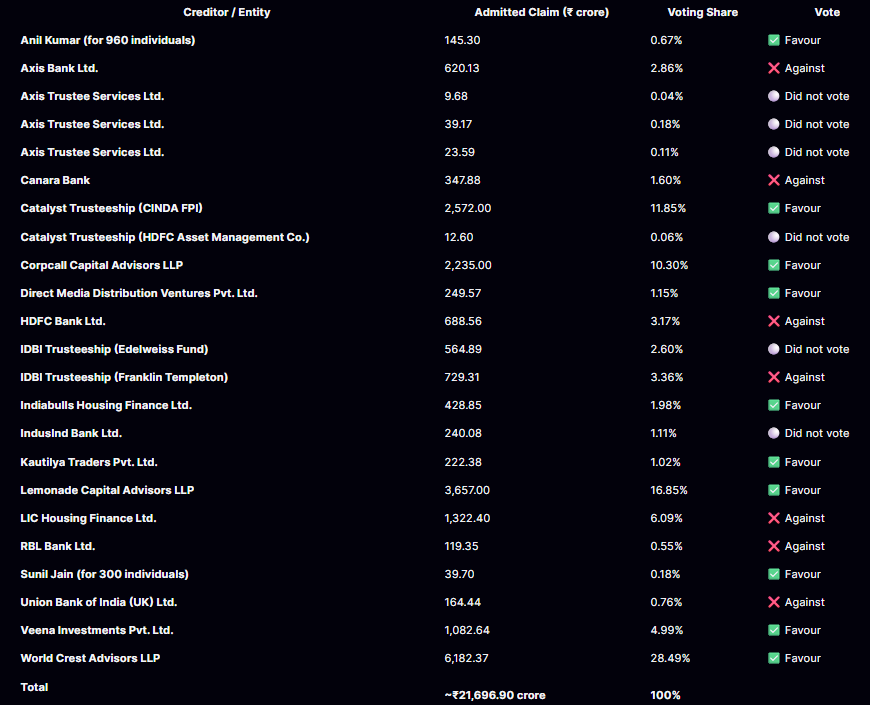
The aggregate total of ₹21,696.90 crore represents the specific sum of admitted claims for the 23 eligible creditors listed in the schedule, whereas the broader ₹22,006.57 crore figure is the widely reported aggregate claim amount for the overall case. Official tribunal documentation notes the eligible creditors’ total independently at ₹21,696.89 crore.
Total Votes in Favour: 77.48%
Total Votes in Against: 18.42%
Total Who did not Vote: 4.10%
There is also now an active legal dispute. HDFC Bank and LIC Housing Finance are preparing to challenge the NCLT decision, so the matter is not necessarily the end of the road.
What Can Forensic Investigators Learn From This Case?
For anyone working in forensic accounting, financial investigations or credit risk, the case offers several valuable lessons.
1. A guarantee is not automatically recoverable
Before relying heavily on a promoter guarantee, understand the guarantor’s actual assets, liabilities, liquidity and existing encumbrances.
2. Follow ownership, not just names
Whenever related-party or independence questions arise, look beyond the legal name of an entity and identify its ultimate beneficial ownership and control.
3. Reconcile major changes in net worth
A significant fall in wealth does not automatically prove misconduct. But it deserves a proper, evidence-backed reconciliation.
4. Separate accounting value from realisable value
An asset may appear to be worth ₹100 crore on paper but generate considerably less when it actually has to be sold.
5. Read the guarantee agreement carefully
- What exactly was guaranteed?
- Was it principal, interest, penalties or multiple facilities?
- Was the guarantee continuing?
- Were there limitations?
- The precise wording can materially change the exposure.
6. Analyse the borrowing entities separately
A personal-guarantor insolvency proceeding does not tell the entire story of the underlying corporate debt.
A forensic investigation may need to trace the entire chain:
Lender → Borrower → Security → Personal Guarantee → Related Entities → Cash Flows → Asset Transfers → Current Recoverability
That is often where the real story emerges.
The Bigger Question
The easiest reaction to the Subhash Chandra case is:
“How can ₹22,000 crore become ₹6.5 crore?”
But perhaps that is not the most useful question.
A better question is:
How did the system reach a point where the realistic recovery from a personal guarantee was only a tiny fraction of the claims attached to it?
That question goes far beyond one businessman.
It touches the core of credit underwriting, promoter guarantees, collateral valuation, corporate governance, financial monitoring and India’s insolvency framework. The NCLT’s decision does not mean that ₹22,006 crore was sitting with Subhash Chandra and was simply reduced to ₹6.5 crore. Nor does it mean that the entire underlying corporate debt has disappeared.
What the case demonstrates is something much more fundamental:
A liability can be enormous on paper while the recoverable assets behind it are surprisingly small.
- For lenders, that is a warning.
- For forensic investigators, it is a trail.
- And for anyone trying to understand financial distress, it is a reminder that the most important number is not always the number appearing on the balance sheet.
Sometimes, the real investigation begins with one simple question:
“Show me where the money went.”
SUMMARY
Subhash Chandra had provided personal guarantees for loans availed by an Essel Group-associated company, including a ₹170 crore facility from Indiabulls. When the company defaulted, Indiabulls initiated insolvency proceedings against Chandra before the NCLT in 2022. Once Chandra’s personal insolvency proceedings were admitted, 22 other creditors filed claims aggregating approximately ₹22,006 crore against him, primarily in his capacity as a guarantor. However, during the insolvency process, the amount considered realistically recoverable from his personal assets was substantially lower. This ultimately resulted in a repayment plan of approximately ₹6.5 crore. The plan received approximately 80.81% approval from the creditors and was subsequently approved by the NCLT. But there is an important distinction here: ₹22,006 crore was not simply “written down” to ₹6.5 crore. The ₹22,006 crore represents claims made against Chandra under personal guarantees, whereas the underlying debt of the respective companies remains a separate matter.
The Dissenting Creditors
The repayment plan was opposed by HDFC Bank, Axis Bank, Canara Bank, RBL Bank, Union Bank and LIC Housing Finance, collectively representing approximately 19.186% of the voting share.
These creditors have raised questions over certain votes supporting the resolution plan, alleging that some of the favourable votes came from entities allegedly connected to Chandra or his family network, including Veena Investments, Direct Media, World Crest, Lemonade Capital and Corpcall.
The dissenting creditors have also questioned the underlying basis of some of the claims. According to their allegations, certain claims were supported by vague or undocumented assurances, without clear loan agreements, dates or other conventional documentation. They further argued that their review of the relevant official financial statements did not show corresponding loans or liabilities owed by Chandra.
In simple terms, their argument was:
– If a liability does not appear in the books or financial records of the parties involved, on what basis should it be recognised as a genuine claim — or be allowed to influence the voting process?The Forensic Question
The banks also sought an independent forensic audit of Chandra’s assets and financial affairs before the repayment plan was approved. However, no such forensic audit was ordered. This is perhaps one of the most important aspects of the case from a forensic perspective. The controversy is not merely about why ₹22,006 crore of claims resulted in a ₹6.5 crore repayment plan. It raises a much broader question:
– What happened to the wealth and assets that were previously associated with Subhash Chandra, and what portion of that wealth was actually available for recovery when the insolvency process began?HDFC Bank may now challenge the NCLT’s decision before the National Company Law Appellate Tribunal (NCLAT).
LATEST UPDATE: NCLT HAS STAYED THE ORDER
Download the full file Now: