
The story of how a successful Italian dairy company built a financial illusion, and how one bank confirmation began to tear it apart. On 19 December 2003, the world of corporate finance was about to learn that one of Europe’s most successful food companies had a problem far bigger than a bad quarter. The Europe’s Enron.
Parmalat, the Italian dairy giant founded by Calisto Tanzi, had spent decades building a global business. Its milk was real. Its factories were real. Its employees were real. Its customers were real. But a very large part of the financial picture presented to investors was not.
At the centre of the crisis was a number that is still remembered today:
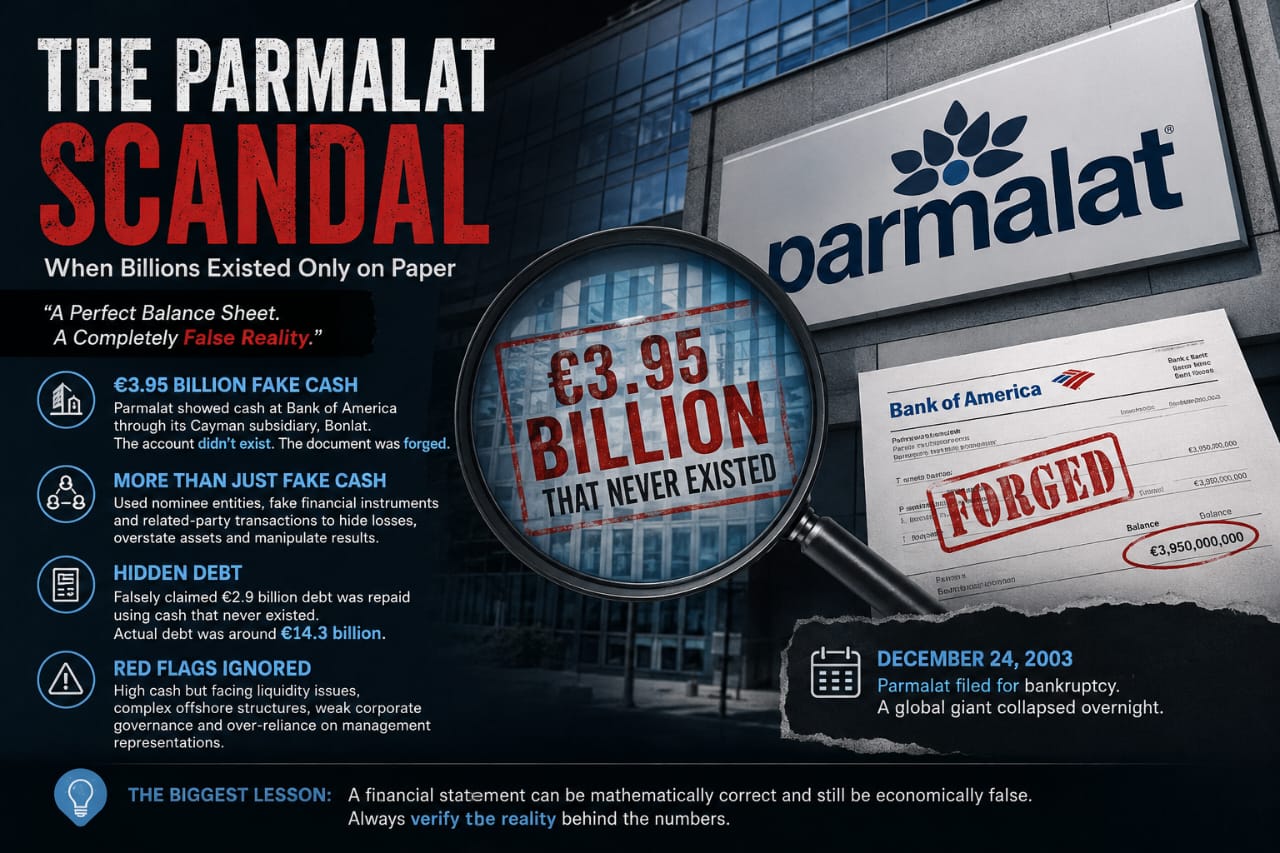
€3.95 billion.
Parmalat said it had that amount in cash and marketable securities. The money was supposedly sitting in an account at Bank of America in New York, held by Parmalat’s Cayman Islands subsidiary, Bonlat Financing Corporation. There was even a document that appeared to confirm it. Then someone checked with the bank. And the entire story began to collapse.
The account did not exist. The assets did not exist. And the purported bank confirmation had been forged. But the €3.95 billion was only the beginning.
From a small dairy business to a multinational empire. To understand Parmalat’s collapse, it is important to understand why the company was trusted in the first place. Calisto Tanzi founded Parmalat in Parma, Italy, in 1961. The company grew rapidly and eventually became a multinational food group operating in more than 30 countries, employing tens of thousands of people. The European Parliament described Parmalat at the time as a major player in the European food industry. This was not a fake company. That is important.
The fraud was not based on pretending that Parmalat itself did not exist. It was based on something much more dangerous: Creating a false financial picture around a real operating business.
As Parmalat expanded, its corporate structure became increasingly complicated. It had numerous subsidiaries, financing arrangements and entities spread across jurisdictions. And underneath the apparent growth, the group was carrying a much larger financial burden than investors understood.
The problem with the numbers
By the early 2000s, Parmalat was increasingly dependent on financing. It needed access to debt markets and banks. And for investors and lenders, one of the most important questions was simple:
- How much cash does Parmalat actually have?
The answer presented in its financial statements appeared reassuring. There was supposedly billions of euros of cash and marketable securities. But according to the SEC, Parmalat’s financial statements had materially overstated assets and understated liabilities.
In August–November 2003, Parmalat even offered $100 million of unsecured Senior Guaranteed Notes to U.S. investors while making material misstatements about its financial condition. The SEC said Parmalat had previously sold nearly $1.5 billion of notes and bonds to U.S. investors between 1998 and 2002. The apparent financial strength therefore mattered enormously.
The stronger the company looked, the easier it was to obtain financing.
Then there was Bonlat, one of the most important pieces of the puzzle was Bonlat Financing Corporation. Bonlat was a wholly owned Parmalat subsidiary incorporated in the Cayman Islands. According to the SEC, Parmalat’s 2002 financial statements represented that Bonlat held approximately €3.95 billion in cash and marketable securities at Bank of America in New York.
This was not a minor balance.
€3.95 billion could completely change how investors looked at a company’s liquidity. If the money was real, Parmalat appeared to have enormous financial resources. If the money was not real, the entire liquidity story changed. The supposed bank confirmation became the critical piece of supporting evidence.
Bonlat’s auditors relied upon a confirmation stating that the assets existed. But the confirmation was false. The SEC stated that the bank account and the assets did not exist and the purported confirmation had been forged. And because Bonlat was consolidated into Parmalat, the fictitious assets did not remain hidden inside an insignificant subsidiary.
They became part of the group’s reported financial position. That is the accounting mechanism that makes the case so important:
Fictitious asset in subsidiary → consolidation → fictitious asset in group financial statements.
The €2.9 billion question
But Parmalat’s problem was not simply that it had too much imaginary cash. It also had too much real debt. In its communications to investors, Parmalat claimed that it had used approximately €2.9 billion of excess cash to repurchase corporate debt securities.
According to the SEC, that statement was false.
The debt had not been repurchased. It remained outstanding. Think about the impact.
If a company genuinely repays €2.9 billion of debt, two things happen:
- Cash decreases.
- Debt decreases.
The company becomes less leveraged.
But if the cash itself is fictitious and the debt remains outstanding, the financial statements create a completely different picture.
The company appears to have:
- more cash than it actually has, and
- less debt than it actually has.
This was therefore not merely an asset-inflation story. It was also a liability-concealment story.
Then investigators started looking underneath the balance sheet. The SEC’s subsequent complaint provides an extraordinary picture of how Parmalat allegedly understated its debt. As of 30 September 2003, Parmalat reported debt of approximately €6.4 billion. The SEC alleged that the actual debt was understated by at least €7.9 billion.
How?
Not through one journal entry. Through multiple mechanisms.
- Approximately €3.3 billion of debt was allegedly eliminated through a purported debt repurchase that had not actually occurred.
- Approximately €1 billion of debt was allegedly recorded as equity through fictitious loan participation agreements.
- Around €500 million of liabilities were allegedly removed through transactions described as non-recourse sales of receivables, even though Parmalat allegedly retained an obligation connected to the ultimate collection.
- Approximately €300 million of debt associated with a Brazilian subsidiary was allegedly eliminated during the sale of that subsidiary.
- Another €300 million of bank debt was allegedly characterized as intercompany debt and therefore eliminated through consolidation.
- Approximately €200 million of Parmalat payables were allegedly eliminated as though they had been paid, although they remained outstanding.
- And a liability of approximately €400 million associated with a put option was allegedly not recorded.
Suddenly, the €3.95 billion fake cash balance starts to look very different.
It was not an isolated trick.
It was part of a much larger effort, according to the SEC’s allegations, to present a financial position that was materially stronger than reality.
Why use so many subsidiaries?
This is where Parmalat becomes particularly interesting from a forensic perspective. Complexity can be useful for legitimate businesses. A multinational company naturally has subsidiaries in different countries. But complexity can also make financial manipulation harder to see.
Imagine investigating one company. You can potentially understand:
- Cash → debt → customers → suppliers → transactions.
Now imagine investigating a group with dozens or hundreds of entities.
The money can move:
- Parent → subsidiary → offshore entity → nominee company → financial institution → another subsidiary.
The accounting records may still balance at every individual entity. But the economic substance of the overall transaction may be very different.
The European Parliament specifically highlighted the role of complex structures, offshore entities and the lack of transparency surrounding the Parmalat affair. It also noted that Parmalat’s gross accumulated debt was estimated at approximately €14 billion, including numerous off-balance-sheet private placements. Forensic investigators therefore have to ask a different question:
- Why was this transaction structured this way?
Not merely:
“Is this transaction recorded correctly?”
Follow the money, and follow the relationships
The investigation also examined transactions involving businesses connected with the Tanzi family. The SEC alleged that between 1997 and 2003, approximately €350 million was transferred from Parmalat to various businesses owned and operated by members of the Tanzi family.
This is precisely the type of transaction that makes related-party analysis critical in a forensic investigation. The existence of a family relationship does not automatically make a transaction fraudulent.
But an investigator would want to know:
- Was the transaction properly disclosed?
- Was there a genuine business purpose?
- Was the price reasonable?
- Were services actually provided?
- Who approved the transaction?
- Where did the money ultimately go?
And most importantly:
- Who benefited?
The warning sign hiding in plain sight: liquidity
Perhaps one of the most interesting red flags was the contradiction between Parmalat’s reported cash and its actual financing needs. If you genuinely have billions of euros sitting in cash, why are you struggling to raise money?
- Why are you issuing bonds?
- Why are lenders becoming increasingly important?
- Why are debt obligations becoming difficult to meet?
These questions became increasingly difficult to ignore during 2003. The SEC’s complaint describes a meeting on 9 December 2003 involving Calisto Tanzi, his son Stefano Tanzi and representatives of a New York private-equity and financial advisory firm.
The representatives referred to Parmalat’s apparently large cash balance. According to the SEC complaint, Stefano Tanzi indicated that the cash was not actually there. The company’s CFO, Fausto Tonna, subsequently indicated that actual debt was around €10 billion, substantially above the reported figure, and acknowledged that the €2.9 billion debt repurchase had not occurred. At this point, the gap between the financial statements and reality was becoming impossible to ignore.
And then came the bank confirmation
This is the moment when the story changes from a complicated financial mystery into an obvious crisis. The supposed €3.95 billion was sitting at Bank of America. So the logical next step was simple:
Ask Bank of America. The bank said the account did not exist.
The purported confirmation was a forgery.
On 19 December 2003, Parmalat acknowledged that the assets reported in its 2002 audited financial statements had been overstated by at least €3.95 billion. A number that had supported Parmalat’s financial strength suddenly disappeared. And once that number disappeared, investors had to question everything around it.
The Collapse
Parmalat’s financial crisis moved incredibly quickly. The company was unable to meet its obligations as expected. The credibility of its financial statements collapsed. On 24 December 2003, Parmalat filed for bankruptcy protection. The company was declared insolvent shortly thereafter.
The investigation then expanded far beyond the original bank account. Investigators examined transactions, subsidiaries, financing arrangements, accounting records and the movement of funds. The European Parliament noted that the investigation was complicated by a lack of documentation at Parmalat’s headquarters and the intentional destruction of computers and files before investigators arrived.
That detail is particularly significant from a forensic perspective. Because once investigators discover that records may have been destroyed, the investigation changes.
The question is no longer simply:
- “What do the records say?”
It becomes:
- “What records should exist, what has disappeared, and what independent sources can reconstruct the missing trail?”
The number became much bigger
As the financial statements were reconstructed, the scale of the problem became clearer.
A subsequent draft PwC review reported that Parmalat’s net financial debt at 30 September 2003 was approximately €14.3 billion, compared with approximately €1.82 billion previously reported. That is an extraordinary difference. The reported number and the reconstructed number were not slightly different.
They were separated by more than €12 billion. This is why describing Parmalat simply as:
- “the €3.95 billion fake cash scandal”
does not tell the full story.
The €3.95 billion was the discovery that opened the door. Behind it was a much larger financial reporting problem.
What went wrong?
It is tempting to look at Parmalat and say:
- “Someone forged a bank confirmation.”
But that explanation is far too small. The case involved multiple layers:
- Fictitious assets
- Concealed debt
- Complex subsidiaries
- Offshore structures
- Questionable transactions
- Related-party dealings
- Misleading financial statements
- Forged documentation
- Financing arrangements
- Corporate governance weaknesses
And, according to the European Parliament, significant questions surrounding the effectiveness and independence of the broader financial oversight system.
The important point is that these elements did not operate independently. They reinforced each other.
- A fictitious cash balance improved the appearance of liquidity.
- Lower reported debt improved leverage ratios.
- Complex structures made transactions harder to understand.
- Financing provided additional time.
- Additional time allowed the financial structure to continue.
Until one external confirmation broke the chain.
What would a forensic investigator have looked for?
This is where Parmalat becomes more than a historical scandal. It becomes a forensic case study. Imagine you are investigating Parmalat before the collapse. You see billions in cash. You don’t simply tick the balance.
You ask:
- “Show me the cash.”
Then you independently contact the bank.
Not using contact information provided solely by management.
- You verify the bank independently.
- You confirm the account.
- You obtain statements.
- You examine subsequent movements.
- You check whether the company actually controlled the funds.
Then you move to debt.
- You don’t simply reconcile the company’s debt schedule.
- You confirm directly with lenders.
- You inspect loan agreements.
- You examine interest payments.
- You search for guarantees.
- You review board minutes.
- You look for debt outside the obvious financing schedule.
Then revenue.
- A €620 million transaction should not be accepted merely because an invoice exists.
You want:
- Contract → invoice → shipment → delivery → customer confirmation → receivable → cash collection.
And if the physical goods supposedly moved, you should be able to find evidence that they actually moved. This is the difference between checking accounting entries and reconstructing economic reality.
The auditors, banks and regulators: a word of caution
This part of the Parmalat story requires particular care. There were extensive allegations and subsequent litigation involving auditors, banks and other professional institutions.
The European Parliament expressed serious concern about the relationships between corporations, banks and auditing firms, and about weaknesses in supervision and corporate governance. But professional reporting should not turn every allegation into an established fact.
There is a fundamental difference between:
- “X was alleged.”
- “X was investigated.”
- “X was found liable in civil proceedings.”
- “X entered into a settlement.”
- “X was criminally convicted.”
A forensic professional should preserve those distinctions.
The objective is not to make the story more dramatic.
It is to make it more accurate.
Why Parmalat still matters
More than two decades later, Parmalat remains an extraordinary forensic accounting case because the central lesson is still relevant. Fraud does not always look like fraud.
Sometimes it looks like: a bank confirmation.
Sometimes it looks like: a perfectly balanced journal entry.
Sometimes it looks like: a legitimate subsidiary.
Sometimes it looks like: a complex financial transaction prepared by professionals.
And sometimes it looks like: billions of euros of cash sitting safely in a bank.
Until someone independently checks.
That is why forensic accounting cannot stop at the question:
- “Does the number reconcile?”
The better questions are:
- Does the asset exist?
- Does the liability exist?
- Did the cash actually move?
- Did the goods actually move?
- Is the counterparty genuine?
- Who controls the entity?
- Who ultimately benefits?
- Who bears the economic risk?
- Does the transaction have commercial substance?
- And does the consolidated financial statement reflect the underlying economic reality?