
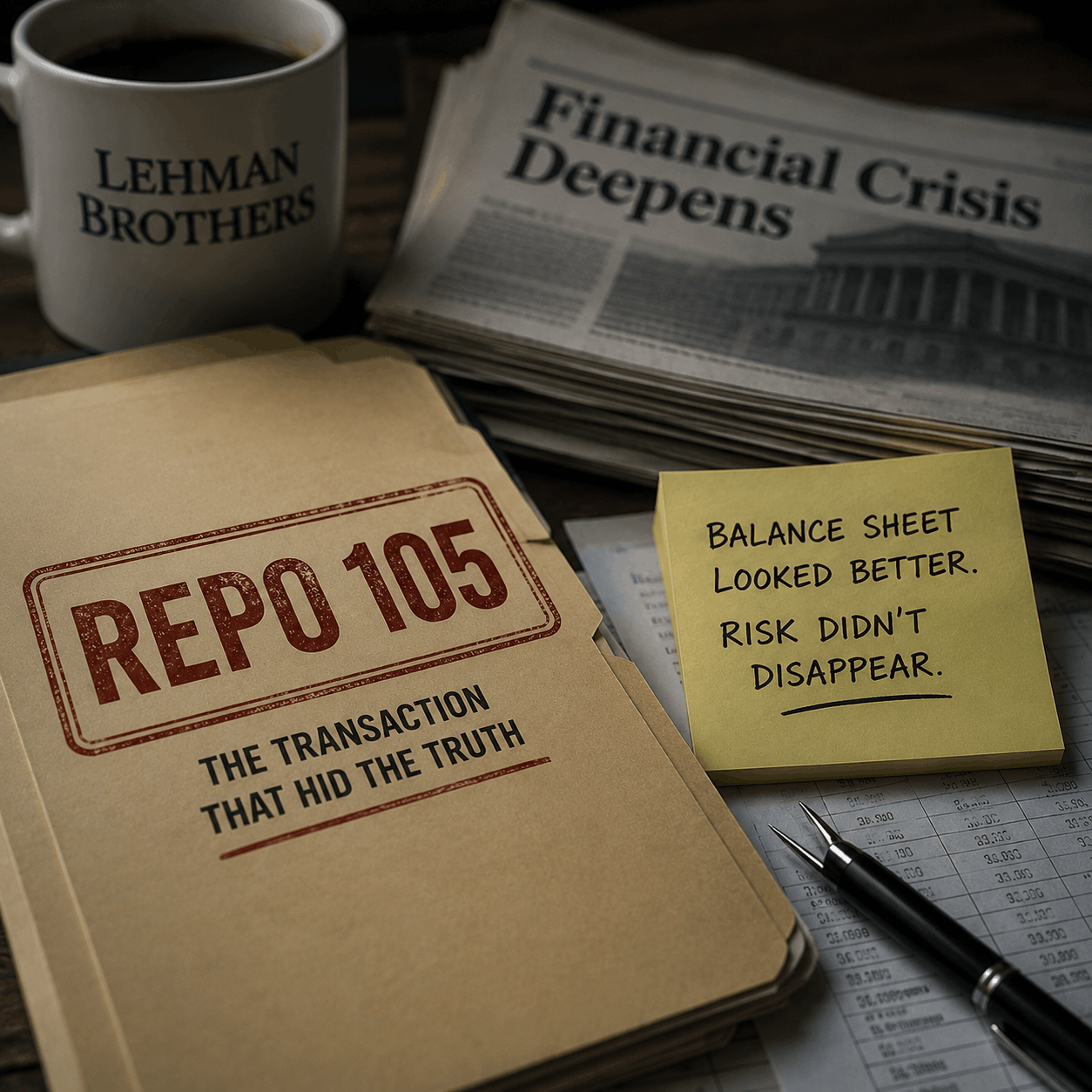
There is something fascinating about the Lehman Brothers story. When people hear about one of the biggest financial collapses in history, they often imagine someone creating fake accounts, stealing money or inventing transactions. But Lehman brother’s story was much more sophisticated than that. The transactions were real. The securities were real. The cash was real. The contracts were real. The problem was what Lehman did with them and, more importantly, why it was doing them at particular points in time. At the centre of this controversy was something called Repo 105.
The Repo Transaction
To understand Repo 105, imagine Lehman Brothers sitting on a mountain of securities. These securities were valuable assets, but Lehman brothers had acquired and financed a huge amount of its business using borrowed money. That meant its balance sheet was enormous and its leverage was extremely high. Lehman needed cash constantly to run its business. One way financial institutions obtain short-term cash is through a transaction called a repurchase agreement, or repo.
The idea is fairly simple.
Suppose Lehman brothers owns securities worth $105 million. It needs $100 million in cash today. It can transfer those securities to another financial institution and receive $100 million. At the same time, Lehman agrees to buy those securities back later. If you look at the economic substance, it looks very much like a short-term loan.
Lehmanbrothers has effectively said: “Give me $100 million today. I will give you securities temporarily and take them back later.”
The other institution gets the securities as protection, while Lehman gets the cash it needs. Normally, this would be reflected as financing on Lehman brother’s balance sheet. The securities would remain on the balance sheet and the cash received would effectively be accompanied by a liability.
Where Repo 105 Changed Everything
But Lehman’s Repo 105 transactions became controversial because they were structured and accounted for as sales rather than financing transactions, based on the accounting treatment and legal opinions being relied upon. And that small difference in accounting classification created a very big difference in Lehman’s reported financial position.
- If it was financing, the securities stayed on the balance sheet.
- If it was treated as a sale, the securities could be removed.
Making the Balance Sheet Look Better
Now imagine the end of a financial quarter is approaching. Lehman brother’s management knows that within days its financial statements will be published. Investors will look at the balance sheet and try to answer one basic question:
“How much risk is Lehman really carrying?”
One of the easiest ways to judge that risk was to look at leverage. The bigger the balance sheet relative to Lehman brother’s capital, the more highly leveraged the bank appeared. Lehman therefore had a strong incentive to make its balance sheet look smaller at the reporting date. This is where Repo 105 became particularly powerful.
Suppose Lehman brother had $1,000 billion of assets and $950 billion of liabilities, with $50 billion of equity. Now, immediately before the quarter ended, Lehman brother enters into Repo 105 transactions involving $100 billion of securities. Lehman transfers those securities and receives approximately $95 billion in cash. Because the transaction is treated as a sale, the securities can be removed from the balance sheet. Lehman then uses the cash to pay down liabilities.
Suddenly, the reported balance sheet might show something closer to:
- $900 billion of assets.
- $855 billion of liabilities.
- $50 billion of equity.
The company has not suddenly become a much safer institution in an economic sense. But the numbers shown to the outside world look better. And this is where the story becomes uncomfortable.
The Quarter-End Game
The transactions were being used around financial reporting dates. Imagine you are selling your house and the buyer asks to inspect it tomorrow. Your house is a complete mess, so instead of actually cleaning it, you put everything into the garage. The buyer walks through the house and sees a clean living room, clean bedrooms and an organised kitchen. The house appears clean. But nothing has really changed. You have simply moved the mess somewhere the buyer is not looking.
That is essentially the concern with balance-sheet window dressing.
The important question becomes: what happened immediately after the reporting date? If the assets that disappeared from the balance sheet suddenly returned, then the reduction in leverage was not necessarily a permanent improvement. The underlying economic risk had not disappeared.
The balance sheet had simply looked better at the moment when investors were looking at it. This is what made Repo 105 so important. It was not merely about obtaining cash. Lehman could have obtained financing through ordinary repo transactions. The attraction of Repo 105 was the accounting effect.
By treating the transaction as a sale, Lehman could temporarily remove assets from its balance sheet. By using the cash to reduce liabilities, it could also reduce the size of its reported balance sheet and improve the appearance of its leverage. And the amounts involved were enormous. This was not a small accounting adjustment buried inside a set of financial statements. The transactions involved tens of billions of dollars around reporting dates.
Forensic View
Once you understand this, you can see why forensic accountants became interested in the transactions. A forensic accountant would not simply look at the journal entry and say:
- “Debit this account, credit that account. Looks fine.”
They would reconstruct the entire transaction, and would ask:
- Who was the counterparty?
- What securities were transferred?
- What was their value?
- How much cash did Lehman receive?
- What did the agreement actually say?
- When did Lehman get the securities back?
- Was there any understanding that the transaction would be reversed?
- Why was the transaction entered into immediately before the reporting date?
- Who authorised it?
- What did management know about its impact on reported leverage?
- Was the transaction being undertaken because Lehman genuinely wanted to sell the securities, or because Lehman wanted its balance sheet to look better at the reporting date?
That question goes directly to the heart of the controversy. This is also why Repo 105 is such a good forensic accounting case. It demonstrates that financial statement manipulation does not necessarily require completely fake transactions.
- The transaction can be genuine.
- The cash can actually move.
- The securities can actually change hands.
- The accounting entry can actually be supported by documents.
Yet the overall presentation can still be misleading if the transaction is being used primarily to create a particular appearance in the financial statements.
And Lehman had a very powerful reason to care about that appearance. By 2007 and 2008, the U.S. housing market was deteriorating rapidly. Mortgage-related securities were losing value. Financial institutions were becoming increasingly nervous about one another. Lehman had significant exposure to the real-estate market, and investors were becoming increasingly concerned about the bank’s leverage and ability to survive.
The pressure on management was therefore enormous.
- Every quarter-end mattered.
- Every published balance sheet mattered.
- Every leverage ratio mattered.
Against this background, reducing the reported size of the balance sheet could make Lehman appear less risky than it otherwise would have.
But there was a fundamental problem.
You cannot make financial risk disappear simply by moving numbers around on a reporting date. If Lehman still had substantial exposure to the same underlying assets and continued to depend heavily on borrowed money, the economic risk remained. Eventually, the broader problems became too large to hide.
The U.S. housing market continued to deteriorate. Lehman brother’s assets suffered losses. Confidence in the institution collapsed. Funding became increasingly difficult. Investors and counterparties became less willing to take risks with Lehman.
And on September 15, 2008, Lehman Brothers filed for bankruptcy. The collapse sent shockwaves through the global financial system.
The Investigation After Lehman Brothers Collapsed
After Lehman’s bankruptcy, investigators began examining how the company had represented its financial position before the collapse. A court-appointed examiner, Anton R. Valukas, conducted an extensive investigation into Lehman’s affairs.
Repo 105 became one of the most important parts of that investigation.
The examiner’s report examined Lehman’s use of Repo 105 transactions around reporting dates and raised serious questions about whether these transactions had been used to make the company’s balance sheet appear less leveraged than it otherwise would have been. The investigation also considered the actions and knowledge of senior management and issues involving Lehman’s external auditor, Ernst & Young.
The Repo 105 controversy therefore became a classic example of window dressing making a company’s financial position appear better at a particular reporting date without fundamentally changing the underlying economic position. But it is important not to misunderstand the case. Repo 105 did not single-handedly “cause” the Lehman Brothers bankruptcy. Lehman was already facing enormous problems because of its exposure to the collapsing housing and mortgage markets, declining asset values, excessive leverage, liquidity pressures and a severe loss of market confidence. Repo 105 was important because it could make the company’s reported leverage look better than it otherwise would have around critical reporting dates. In other words, Repo 105 was part of the story of how the true extent of Lehman’s financial condition could be obscured; it was not the sole reason Lehman failed.
The Lehman Brothers story is therefore remembered not simply because a huge investment bank collapsed, but because it demonstrated how sophisticated financial transactions and accounting judgments can be used to create a more favourable picture of a company’s financial condition.
Don’t just ask what the financial statements say. Ask what happened before the number appeared there.